
ICD-10, CPT, and HCPCS Codes: A Guide to Medical Coding Systems
A doctor writes one line, right knee osteoarthritis, office visit, X-ray done. That’s it. But that one line has to become three different codes before a claim can go out. One code for why the patient came, one for what was done, and sometimes a third for a brace or injection.
That’s the part where most new billers get confused. And that’s exactly why medical coding systems exist.
What Are Medical Coding Systems?
Basically, medical coding systems are a common language. Healthcare can’t run on long paragraphs. Payers, hospitals, clearinghouses, everyone needs to read the same note and get the same meaning in seconds.
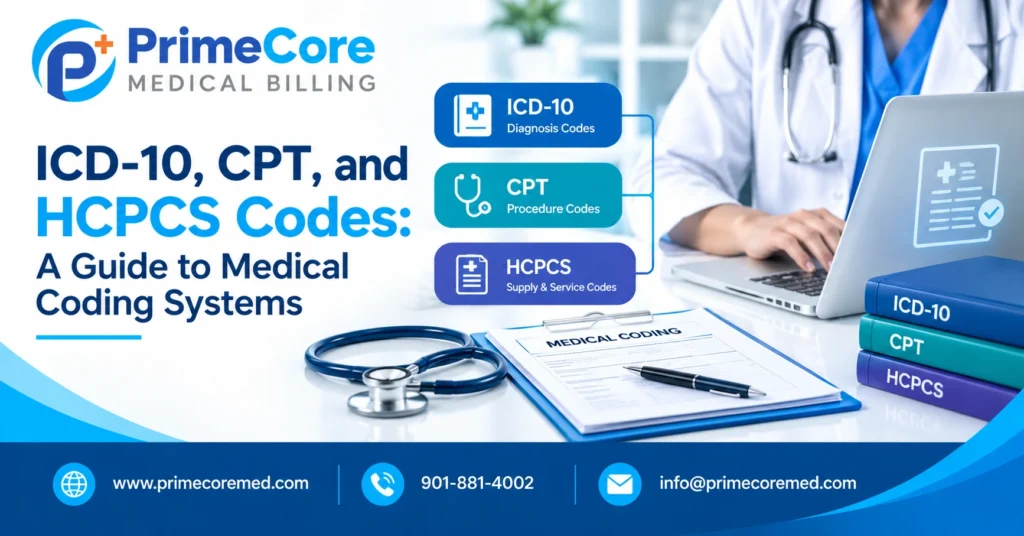
So instead of sentences, we use codes. In the U.S., almost every claim runs on three systems — ICD-10-CM for diagnoses, CPT for professional services, and HCPCS for supplies, drugs, and equipment. This trio is the base of diagnosis and procedure coding.
You can think of them as medical coding classification systems made by different organizations but built to work together. CDC maintains ICD-10-CM, the American Medical Association maintains CPT, and CMS handles HCPCS Level Two. Each has its own calendar and rulebook.
Types of Medical Codes You Will See Every Day
In real practice, you don’t deal with dozens of sets. You deal with three types of medical codes:
- ICD-10-CM: tells the payer what’s wrong — diagnosis, symptom, reason for visit
- CPT / HCPCS Level One: tells the payer what the provider did — office visit, surgery, X-ray, lab
- HCPCS Level Two: tells the payer what product was used — drug, brace, walker, ambulance ride
Mix these up and the claim falls apart, even if everything else is correct.
ICD-10 — The Reason for the Visit
ICD-10-CM is the diagnosis side. Full name is long, everyone just calls it ICD-10. Over 70,000 codes, covering everything from common cold to complicated injuries. Each code is 3 to 7 characters.
Those extra characters add detail. For example, E11.9 means Type 2 diabetes without complications, while E11.65 means Type 2 with hyperglycemia, and E11.42 means Type 2 with diabetic polyneuropathy. Same disease family, totally different story.
Payers look closely at that detail laterality, acuity, cause, complications. Writing right knee pain is not enough when the note clearly says primary osteoarthritis of the right knee. M25.561 vs M17.11 changes how medical necessity looks.
This is where good ICD-10 coding services matter. It’s not just picking a code from a list. It’s reading the note, checking if the provider actually linked two conditions, following sequencing rules, and using combination codes when guidelines say so. Clinics that guess too much end up with lots of unspecified codes, and those get denied fast.
Rule is simple, if it’s not documented, you can’t code it.
CPT — What Was Actually Done
CPT means Current Procedural Terminology. If ICD-10 is the why, CPT is the what. Almost every service a provider performs in clinic or hospital has a CPT code.
CPT is divided into sections, and once you see the pattern it makes sense:
- Evaluation and Management, 99202-99499: for office visits and hospital visits
- Anesthesia, 00100-01999
- Surgery, 10021-69990
- Radiology, 70010-79999
- Pathology and Laboratory, 80047-89398
- Medicine, 90281-99607: for vaccines, cardiac tests, and other procedures
Five digits, but modifiers make it tricky. Modifier 25 means a significant, separately identifiable E/M service on the same day as a procedure. Modifier 59 means a distinct service. LT and RT show left and right. Use them wrong and you get bundling denials.
CPT updates every January. E/M rules now focus more on medical decision making and total time, not just how many history bullets were checked. Many practices missed that shift and kept coding the old way.
That’s why professional CPT coding services are valuable, keeping up with parenthetical notes, CPT Assistant, and payer edits is a full-time job.
HCPCS — Drugs, Supplies, and More
HCPCS confuses people because of the two levels. Level One is actually CPT. So 99213 is both a CPT code and a HCPCS Level One code.
Level Two is the set that starts with a letter. J codes for drugs, L codes for orthotics, A codes for ambulance and supplies. J1100 is dexamethasone injection. L0650 is a lumbar-sacral orthosis. A0428 is ambulance.
CMS maintains this set and updates it quarterly, not yearly. That matters a lot for drug codes.
Billing HCPCS Level Two needs extra attention. Units must match the code description, not the vial size. Wastage needs documentation when required. Local coverage determinations often add more rules for DME.
Typical categories include:
- Injectable and infused drugs, especially chemo and biologics
- Durable medical equipment, prosthetics, orthotics, and supplies (DMEPOS)
- Ambulance rides, preventive screenings, and services without a CPT code
Miss the unit calculation and the claim bounces even if diagnosis and procedure codes are perfect. Strong HCPCS coding services always double-check that math.
ICD-10 vs CPT Codes — You Need Both
A lot of people search ICD-10 vs CPT codes thinking it’s one or the other. It’s not. You need both on almost every claim.
ICD-10 tells the payer this is the patient’s condition. CPT tells the payer this is what was done about it. Medical necessity is proven when the why supports the what.
Bill a knee X-ray with only a wellness exam diagnosis and the payer won’t see why the X-ray was needed. Bill diabetes without complications but do a detailed foot exam for neuropathy, and the story doesn’t line up.
HCPCS Level Two comes in only when a product was part of the care.
| System | What It Reports | Example |
| ICD-10-CM | Diagnoses and conditions | M17.11 primary osteoarthritis, right knee |
| CPT / HCPCS Level One | Services and procedures | 99213 office visit, 73560 knee X-ray |
| HCPCS Level Two | Drugs, supplies, equipment | J1100 dexamethasone, L0650 back brace |
That’s how a clean claim is built.
How Diagnosis and Procedure Coding Link
Take a real example. 62-year-old with right knee pain for three months. Provider documents right knee primary osteoarthritis, does an established visit and orders two views of the knee. No injection today.
Diagnosis coding gives M17.11. Procedure coding gives 99213 and 73560. Both procedures link to M17.11.
Now link that X-ray to a shoulder sprain by mistake, both codes are valid alone, but together they make no sense. That’s a classic medical necessity denial.
Good workflows always check linkage before submission. That one quick check saves hours of rework later.
Why Medical Coding Guidelines Matter
Medical coding guidelines are the rulebooks. Without them, two coders could code the same chart two different ways.
For ICD-10, there are official guidelines for sequencing, combination codes, diabetes, hypertension, and more. For CPT, the codebook notes and CPT Assistant provide direction. For HCPCS Level Two, CMS manuals, NCCI edits, and LCDs tell you what’s covered and how.
They cover when to use symptoms versus definitive diagnosis, how to code laterality, how to sequence primary and secondary diagnoses, when time matters for E/M, and when a modifier is truly needed.
Updates happen regularly — ICD-10-CM every October, CPT every January, HCPCS Level Two quarterly. Skip an update and you might bill a deleted code without knowing.
Getting It Right
Most denials come from the same few mistakes:
- Unspecified ICD-10-CM when specifics are in the note
- E/M level that doesn’t match decision making or time
- Modifier 25 without a truly separate service
- Ignoring NCCI bundling
- Billing drug units by vial instead of HCPCS definition
Not fraud, just process gaps. But it slows cash and raises audit risk.
That’s why many practices evaluate ICD-10 coding services, CPT coding services, and HCPCS coding services as part of revenue cycle management. When coding is done right, the clinical story turns into a clean, payable claim without back-and-forth.