
Medical Coding vs. Medical Billing: Key Differences Healthcare Providers Should Know
Look, you close your chart after seeing a patient, you’ve documented the HPI, exam, diagnosis, plan. You think your job is done.
It’s not.
That note now has to get paid. And that’s where most practices mess up because they think coding and billing is the same thing.
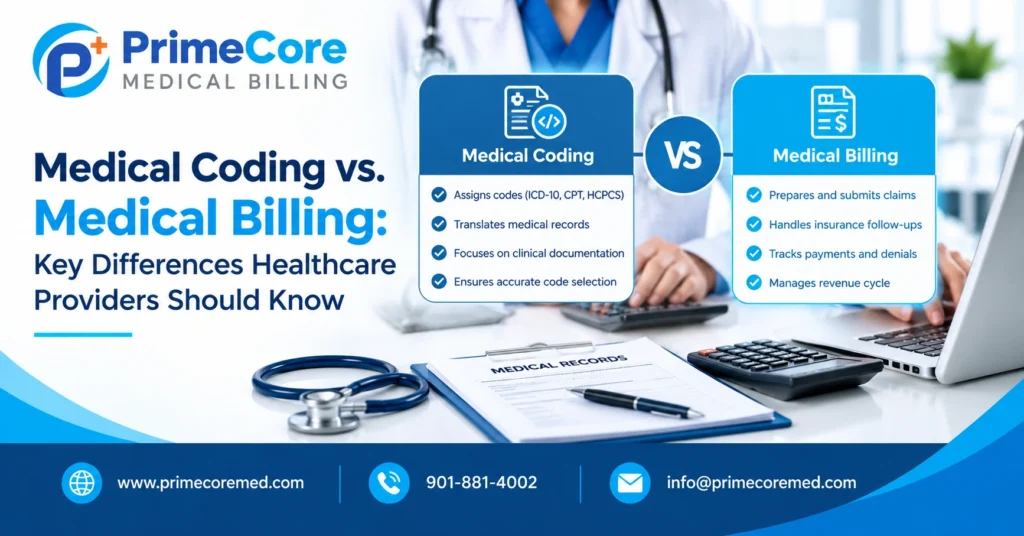
Medical coding vs medical billing one is about translating your clinical work into codes. ICD-10, CPT, HCPCS. What was the diagnosis? What procedure did you do? Did your MDM support a Level 4?
Billing is what happens after that. Taking those codes, putting them on a claim, adding the right modifier, sending it to the payer, and actually fighting to get that money back.
If coding is wrong, billing fails. If billing is weak, you don’t get paid even when coding is perfect.
What Is Medical Coding, Really?
Medical coding is translation work. But not English to Spanish. A doctor sees a patient and writes a note. That note is long, messy, full of medical terms.
“Patient presents with acute low back pain radiating to left leg, positive straight leg raise, MRI recommended, diagnosis L4 L5 radiculopathy.”
An insurance company will never read that. Ever.
So a medical coder reads that note and converts it into codes that every payer in the US understands. We have three main code sets we use every single day.
ICD 10 for diagnosis: What’s wrong with the patient.
CPT for procedures: What did the doctor do?
HCPCS for supplies and drugs: What else was used?
So that low back pain case becomes M51.16, plus codes for the exam, plus maybe a code for the MRI order.
This is the real role of medical coding in healthcare. It’s not just paperwork. The codes tell the payer if what you did was medically necessary. If you code a knee X ray with a diagnosis of headache, you will never get paid. The codes connect the why with the what.
And here is the scary part. If you code it wrong on purpose, even by mistake, that’s called upcoding. And that can trigger an audit. A good coder doesn’t just maximize your revenue. She protects your license.
And What Is Medical Billing Then?
If coding is translation, billing is fighting for money.
Once the codes are done, the biller takes over. She takes all those codes, puts them into a claim form called CMS 1500, double checks everything, and sends it to the insurance.
Billing is where medical coding and claims processing turns into actual cash in your bank.
A coder’s job ends when the codes are correct. A biller’s job ends when the money is in the bank. And between those two points, a lot can go wrong. Eligibility issues, prior auth missing, timely filing limits, credentialing problems.
A coder doesn’t usually talk to patients. A biller does, every day.
“Why did I get this bill?” “My insurance should have paid this.” That’s all billing.
The Main Difference Between Medical Billing and Coding: No Fluff
This simple comparison for a clinic owner last month and she finally said, “Okay, now get it.” So sharing it with you.
1. The Question They Ask
A coder asks: “What exactly did the doctor do and why?”
A biller asks: “How do we get paid for it, and how fast?”
2. The Skill Set
To understand medical coding vs billing responsibilities, you have to look at skills.
Coders need to know anatomy, physiology, and medical terminology. They need to be certified, such as CPC or CCS. They live in coding books and encoder software.
Billers need to know payer rules. Like, did you know United Healthcare requires modifier 25 in a different way than Connecticut Medicaid does? A biller knows that. They live in practice management software and clearinghouses like Availity or Waystar.
3. The Tools
Coder uses: EHR notes, 3M encoder, ICD 10 manuals.
Biller uses: Billing software, ERA files, denial reports, phone. Lots of phones.
4. The End Goal
Coder’s goal: Accuracy and compliance.
Biller’s goal: Clean claims and fast payments.
That’s the core difference between medical billing and coding. One makes sure the story is told right. The other makes sure you get paid for telling it.
Let Me Walk You Through the Real Medical Billing and Coding Workflow
Forget the textbook diagram. This is how the medical billing and coding workflow actually happens in a busy practice in Connecticut.
Step 1: Front Desk. It Starts Before the Patient Comes In
The patient calls for an appointment. Your staff takes their insurance card. They check eligibility.
Is the plan active?
Is there a copay?
Do we need prior auth for that MRI?
If you skip this, you will lose money. This is 100% billing.
Step 2: The Doctor’s Note. This Is Everything
The doctor sees the patient and types the note in eClinicalWorks or Athena.
Now, if the doctor just writes “follow up, doing fine,” the coder has nothing. A good coder will go back and ask, “Doing fine for what? What’s the diagnosis status?”
The better the documentation, the better the coding. I can’t stress this enough.
Step 3: The Coding Part
This is the heart of the medical billing and coding process.
The coder reads the note, picks the right diagnosis codes and procedure codes, and adds modifiers if needed.
For example, if the doctor did a physical and also treated a sore knee on the same day, the coder has to add modifier 25 or the physical will get denied.
This is where medical coding and claims processing gets technical.
Step 4: Claim Scrubbing and Submission
Now the biller gets the codes. She enters charges and checks for errors. Wrong date of birth.
Missing NPI. Wrong place of service. Software will do a first scrub, but a good biller manually checks too. Then she hits submit.
The claim goes to the clearinghouse, then to the payer.
Step 5: The Waiting and the Fighting
This is where most in house teams fail.
The payer sends back an ERA. Some claims paid, some denied. The biller has to post payments, and for denied claims, she has to work AR.
Why was it denied?
Is it CO 197, authorization missing?
Or CO 50, not medically necessary?
That tells us if it was a coding error or billing error. And the cycle repeats.
Why This Matters for Your Money
Look, you didn’t go to medical school to chase claims. But when you don’t separate these two roles, here’s what happens.
If your denials are for “NCCI edits,” “modifier missing,” or “diagnosis inconsistent with procedure,” that’s a coding issue.
Your medical coding vs medical billing problem is on the coding side.
If your denials are “timely filing exceeded,” “patient not eligible,” “no prior auth,” or your AR is over 60 days, that’s a pure billing issue.
Experts audited a practice in Stamford last year. They had one person doing both. She was amazing, but overwhelmed. She was so busy sending claims that she didn’t have time to check coding updates for 2026.
Result? 22% of their claims were under coded. They were legally owed more money, but they were coding low to avoid denials.
We fixed the medical billing and coding process, separated the jobs, and their monthly collections went up by $14,000.
That’s why so many smart practices now use professional medical billing and coding services.
You don’t need to hire two full time people. You outsource and you get a whole team. A certified coder and an experienced biller for less than one salary.
So What Should You Do?
Stop asking your front desk to do coding. Stop asking your coder to call insurance.
If you want to grow in 2026, treat them as two expert jobs. At PrimeCore Medical Billing, this is all we do. We work with small to medium practices all over USA.
Our coders are certified and stay updated on every payer change. Our billers make sure your claim goes out clean in 24 hours and gets followed up until it’s paid.
We understand the medical billing and coding workflow because we live it every day. We know what Connecticut payers want.
Bottom Line
Medical coding tells the payer what happened. Medical billing makes sure you get paid for what happened. You need both to be perfect.
If you’re not sure where your practice is losing money, is it coding or billing? Let us tell you. We offer a free, no obligation denial report audit.
Send us your last denial report and we’ll show you exactly where the leak is.